
¿Qué se requiere para transformar una comunidad?
La serie Community Spotlight le presenta a los miembros dinámicos de la Colectiva de Transformación Comunitaria (CTC) que opera en Best Start Región 1 (BSR1). Estos miembros incluyen promotores y líderes comunitarios que construyen movimientos y crean cambios duraderos en sus comunidades. Estas historias describen su trayectoria personal al capacitarse, generar confianza y apalancar su liderazgo para encontrar nuevos caminos hacia el cambio para ellos mismos, sus familias y sus comunidades.
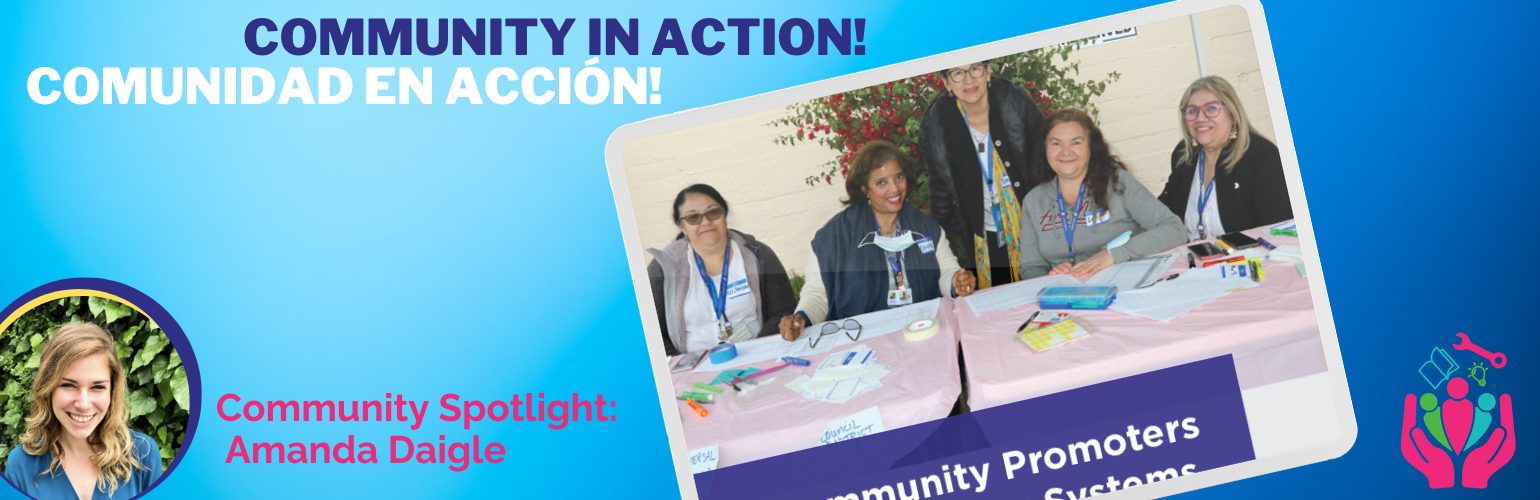
Presentamos a Amanda Daigle
En 2018, comenzó una asociación entre la Colectiva de Transformación Comunitaria (CTC) y uno de los sistemas de salud pediátrica más grandes del Condado de Los Ángeles - y creció a ser algo mucho más poderoso de lo que se podría haber imaginado o predicho. Empezó sencillamente, como muchas cosas significantes: dos organizaciones que servían a la misma comunidad, notando las mismas brechas y haciendo la misma pregunta - ¿cómo podemos trabajar mejor para las personas que dependen de nosotros?
Al principio, la colaboración fue informal. Las conversaciones fluyeron, se intercambiaron ideas y la confianza empezó a echar raíces. Con el tiempo, esa confianza se evolucionó a algo más fuerte - un compromiso compartido para entender, no tan solo las necesidades médicas de los pacientes sino también las realidades que forman sus vidas fuera de las paredes de la clínica. Porque lo que se encontró vez tras vez fue lo siguiente: la salud no empieza ni termina en un hospital.
Amanda, quien trabajó en este proyecto en ese entonces, reflexionó, “Había tantas necesidades sociales y no teníamos cómo manejarlas. Eso es lo que hizo que esta asociación fuera, no tan solo útil, sino necesario”.
Amanda entendió muy claramente que había barreras que enfrentaban los pacientes que ninguna receta podía arreglar. Las citas fallidas no eran por una falta de interés - eran por una falta de acceso. La inseguridad alimentaria, retos de transportación, aislamiento - todos fueron fuerzas invisibles que formaban los resultados de salud de los pacientes. Y el sistema tradicional de cuidado médico, por todo su conocimiento, no se creó para solucionarlo solo. Así que se profundizó la Colectiva de Transformación Comunitaria.
Juntos crearon algo nuevo - una estrategia con sus raíces en la afirmación cultural y respeto y en la que el conocimiento clínico y la sabiduría comunitaria son iguales. Las trabajadoras comunitarias, promotoras, se convirtieron en el puente. Llevaban con ellas su experiencia vivida, una verdad que ninguna institución podía duplicar y empleaban prácticas que afirman sus culturas. Y tal vez por primera vez, no solo se incluyeron tales voces, sino que las pusieron al centro.
“Creo que el cambio más grande para mí”, dijo Amanda, “fue darme cuenta de que la comunidad son los expertos. Cuando empieza a entender eso, cambia todo”.
Hubo un momento que captó tal transformación. En una reunión diseñada para fomentar la colaboración, un trabajador social y una promotora se sentaron el uno con el otro hablando sobre un paciente compartido. La jerarquía del sistema permanecía en el fondo, como siempre - títulos, diplomas, expectativas. Pero entonces ocurrió algo. La promotora se acercó y preguntó, “¿Puedo ofrecer algo de consejo?”
Y la respuesta fue que “sí”. En ese momento, cambió algo fundamental. Ya no se definía el conocimiento por las credenciales solo. Se definía por conexión, comprensión, cercanía a la comunidad misma. El trabajo llegó a ser algo mutuo. Y la visión - que una vez fue una esperanza - se hizo algo real. El impacto se apareció en maneras pequeñas y poderosas.
Finalmente se pudo alcanzar a una madre que había faltado a varias citas - no la alcanzaron por recordatorios o referencias, sino mediante una conversación. El obstáculo real no fue una falta de cumplimiento; fue la falta de un carrito parabebé, que hizo que fuera casi imposible navegar el transporte público con su hijo. Dentro de unos días, un carrito llegó a su casa. Poco después, asistió a su cita. Fue una solución sencilla. Pero requirió escuchar de manera diferente.
Amanda dijo, “Su vida no termina cuando sale de la clínica. Todo lo que está a su alrededor - su comunidad, su sistema de apoyo - contribuye a su salud. Nos tiene que importar todo”.
Momentos así revelaron lo que es posible cuando los sistemas eligen asociación más de control y humildad sobre suposiciones. El trabajo no fue fácil. Requirió persistencia, defensa y campeones en todo nivel. Desafió normas duraderas y pidió que instituciones cambiaran la manera de tomar decisiones - y quiénes las pueden tomar. Pero también comprobó algo: cuando invierte en la gente, cuando confía en las comunidades, cuando edifica con - en vez de por - crea cambio duradero. Para los que participaron, la experiencia dejó una huella permanente.
Cambió su forma de ver al cuidado médico - no como un sistema cerrado, sino como algo que está profundamente conectado con las vidas diarias de las personas. Reforzó una verdad sencilla pero ignorada: las personas que son más afectadas por las decisiones, deben ayudar a dirigir el proceso para tomarlas.
Y, tal vez lo más importante, ofreció esperanza. Esperanza de que aun en los sistemas más complejos, el cambio es posible. La esperanza de que las asociaciones edificadas sobre el respeto mutuo pueden transformar los resultados. La esperanza es que cuando escuchamos de verdad, no solo solucionamos problemas, sino creamos algo mejor para el cambio duradero.
Porque al final, no tenía que ver sólo con un programa o asociación. Tenía que ver con reimaginar cómo puede ser la atención médica - cuando todos tienen un puesto en la mesa.
¿Qué es la Colectiva de Transformación Comunitaria?
Best Start Región 1 (BSR1) es un movimiento de construcción comunitaria basado en el lugar, compuesto por más de 1.000 residentes de la comunidad y organizaciones socios intersectoriales que trabajan juntos para efectuar cambios en su región. Con una inversión inicial de First 5 LA, esta región incluye las comunidades del Este de Los Ángeles, Metro Los Ángeles, Sur El Monte/El Monte y el Sureste de Los Ángeles.
La Colectiva de Transformación Comunitaria (CTC) dentro de Para Los Niños guía a BSR1. La CTC apoya a los miembros de la comunidad para transformar las condiciones sistémicas para que los niños, las familias y los vecindarios puedan prosperar. Esta estrategia de cambio de sistemas fortalece y cultiva colaboraciones transformadoras en la región para diseñar juntos, implementar, comunicar, movilizar y evaluar estrategias.
What does it take to transform a community?
The Community Spotlight series introduces you to the vibrant Community Transformation Collective (CTC) members operating in Best Start Region 1 (BSR1). These members include community leaders and promoters who build movements and create lasting change in their communities. These stories describe their personal journey as they develop skills, build confidence, and leverage their leadership to find new pathways to change for themselves, their families, and their communities.
Meet Amanda Daigle
In 2018, a partnership began between Community Transformation Collective (CTC) and one of the largest pediatric health systems in Los Angeles County- that grew into something far more powerful than anyone could have imagined or predicted. It started simply, as so many meaningful things do: two organizations serving the same communities, noticing the same gaps, and asking the same question - how do we do better for the people who rely on us?
At first, the collaboration was informal. Conversations flowed, ideas were exchanged, and trust slowly took root. Over time, that trust evolved into something stronger - a shared commitment to understanding not just patients’ medical needs, but the realities shaping their lives beyond clinic walls. Because what became clear, again and again was this: health doesn’t begin or end in a hospital.
Amanda, who at the time worked on this project, reflected, “There were so many social needs, and we didn’t have the means to manage them. That’s what made this partnership not just helpful, but necessary.”
Amanda understood very clearly that there were barriers patients were experiencing, that no prescription could fix. Missed appointments weren’t about a lack of caring - they were about lack of access. Food insecurity, transportation challenges, isolation - these were the invisible forces shaping patients’ health outcomes. And the traditional healthcare system, for all its expertise, wasn’t built to solve them alone. So the partnership with Community Transformation Collective deepened.
Together, they built something new - an approach rooted in cultural affirmation, respect, and where clinical knowledge and community wisdom stood side by side. Community health workers, promoters, became the bridge. They carried lived experience, a truth that no institution could replicate, and employed culturally affirming practices. And for perhaps the first time, those voices were not just included but were centered.
“I think the biggest shift for me,” Amanda shared, “was realizing that the community are the experts. When you begin to understand that, everything changes.”
There was a moment that captured that transformation. In a meeting designed to foster collaboration, a social worker and a promoter sat across from one another discussing a shared patient. The system’s hierarchy lingered in the background, as it often does - titles, degrees, expectations. But then something happened. The promoter leaned forward and asked, “Can I offer some advice?”
And the answer was “yes.” In that moment, something fundamental changed. Expertise was no longer defined by credentials alone. It was defined by connection, by understanding, by proximity to the community itself. The work became mutual. And the vision - once aspirational - became real. The impact showed up in small, powerful ways.
A mother who had missed multiple appointments was finally reached - not through reminders or referrals, but through conversation. The real issue wasn’t compliance; it was a lack of a stroller, making it nearly impossible to navigate public transportation with her child. Within days, a stroller arrived at her doorsteps. Soon after, she made it to her appointment. It was a simple solution. But it required listening differently.
Amanda said, “Your life doesn’t end when you leave the clinic. Everything around you - your community, your support system - shapes your health. We have to care about all of it.”
Moments like these revealed what was possible when systems chose partnership over control, and humility over assumption.The work wasn’t easy. It required persistence, advocacy, and champions at every level. It challenged long-standing norms and asked institutions to rethink how decisions are made - and who got to make them. But it also proved something essential: when you invest in people, when you trust communities, when you build with - not for- you create change that lasts. For those involved, the experience left a permanent mark.
It reshaped how she sees healthcare - not as a closed system, but as something deeply interconnected with the lives people lead every day. It reinforced a simple but often overlooked truth: the people most impacted by decisions should help lead the process to make them.
And perhaps most importantly, it offered hope. Hope that even in complex systems, change is possible. Hope that partnerships built on mutual respect can transform outcomes. Hope that when we truly listen, we don’t just solve problems - we build something better for lasting change.
Because in the end, this wasn’t just about a program or a partnership. It was about reimagining what care could look like- when everyone has a seat at the table.
What is the Community Transformation Collective?
Best Start Region 1 (BSR1) is a place-based, community-building movement made up of over 1,000 community residents and cross-sector organizational partners who work together to affect change in their region. With an initial investment from First 5 LA, this region includes the communities of East Los Angeles, Metro Los Angeles, South El Monte/El Monte, and Southeast Los Angeles.
BSR1 is driven by the Community Transformation Collective (CTC) within Para Los Niños. The CTC supports community members to transform systemic conditions so that children, families, and neighborhoods can thrive. Our systems change approach builds and cultivates transformational partnerships for the region to co-design, implement, communicate, mobilize, and evaluate strategies.